Leila Fadel : NPR
| Total Responses: | 2 |
| Average Quality Score: | 67.5 |
| Average Bias Score: | 3.5 |
| gen: 2026/10/24:22:10 in 32.1 sec (-1d)bias: 3 (Center) |
| type: lolsquality: 65 |
| pts: 0 |
 | author: | Leila Fadel | institution: | NPR | ¿porque no los dos? |
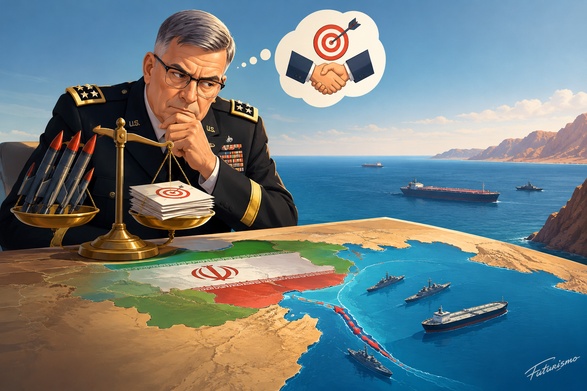
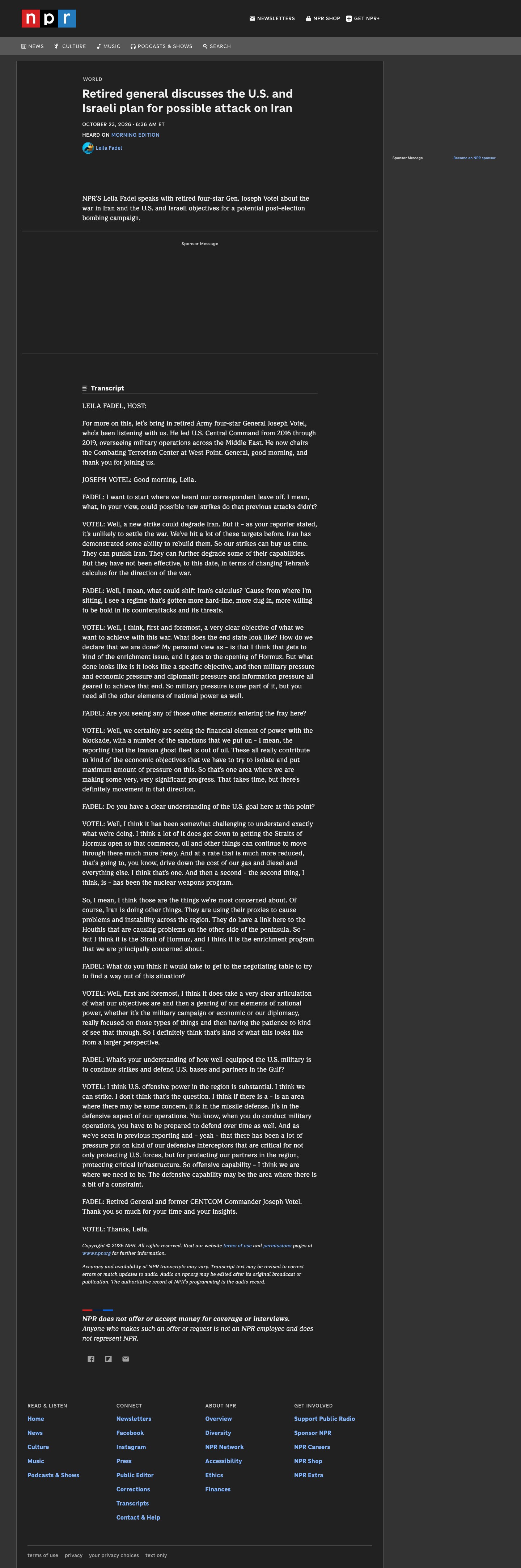
| tl;dr | Leila Fadel interviews retired Gen. Joseph Votel about potential additional U.S.-Israeli strikes on Iran. Votel argues that bombing can weaken Iranian capabilities but is unlikely to end the war alone. He calls for clear objectives supported by coordinated military, economic and diplomatic pressure, highlighting nuclear enrichment and reopening the Strait of Hormuz. He also warns that defensive interceptor supplies could constrain U.S. operations despite substantial offensive strength. | ||||
| deeper: | The interview uses measured language and probes military effectiveness, unclear goals and negotiations. Its framing privileges U.S. strategic interests, with no Iranian or civilian perspectives, but shows no clear partisan alignment. Votel’s expertise and explicit qualifications strengthen the analysis. However, claims about sanctions, oil supplies and nuclear weapons lack supporting evidence here. The headline promises discussion of an Israeli plan that the transcript barely addresses. These scores assess the visible text; the screenshots alone do not establish authenticity or verify the reported events. | ||||
media: | |||||
| gen: 2026/09/01:15:51 in 33.8 sec (old)bias: 4 (Center) |
| type: newsquality: 70 |
| pts: 0 |
 | author: | Leila Fadel | institution: | NPR | ¿porque no los dos? |
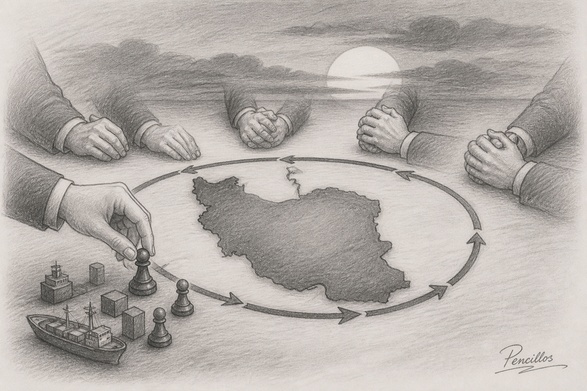
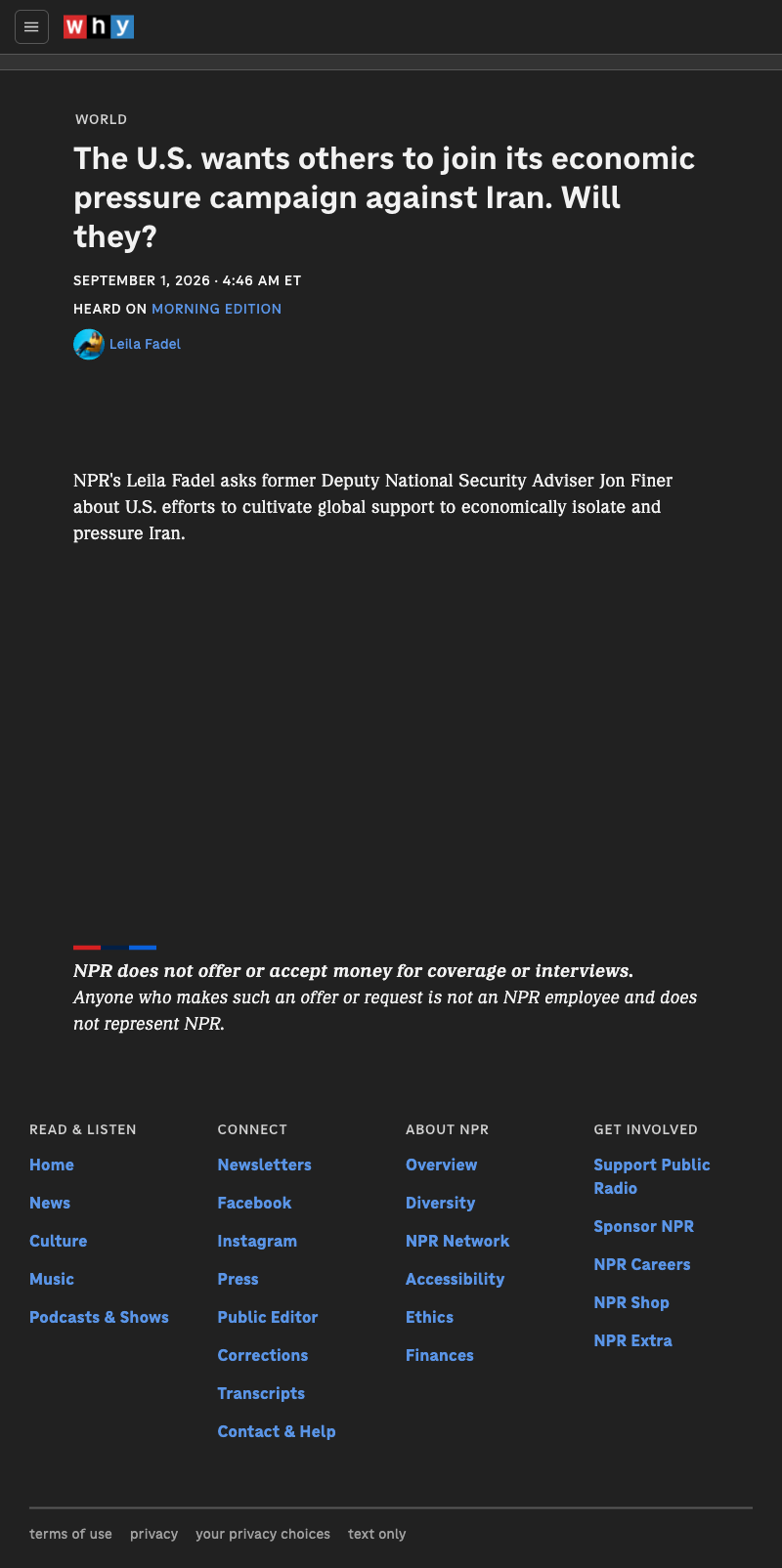
| tl;dr | The image shows an NPR World/Morning Edition item titled “The U.S. wants others to join its economic pressure campaign against Iran. Will they?” It’s framed as an interview in which Leila Fadel questions former Deputy National Security Adviser Jon Finer about U.S. efforts to build international support to economically isolate and pressure Iran. The page excerpt indicates the segment focuses on coalition-building and sanctions-style pressure, with the core perspective coming from a senior U.S. official/alumnus rather than multiple stakeholders. | ||||
| deeper: | The framing is largely explanatory and question-driven, but the sourcing shown is narrow: it spotlights a former top U.S. national security official, which tends to privilege Washington’s rationale and language (“pressure campaign,” “isolate”). Without evidence in the screenshot of Iranian, allied, humanitarian, or independent economic perspectives, the segment risks becoming an insider-policy account rather than a fully rounded analysis. Still, NPR’s format and the headline’s interrogative stance suggest an intent to test assumptions rather than simply promote policy. | ||||
media: | |||||
You made it to the bottom. Now dance!


owned and operated by: RPN Omnigalactic Insitutution as of: 2026/10/25: 18:56 in 0 ms
Enter Code
Login with Account